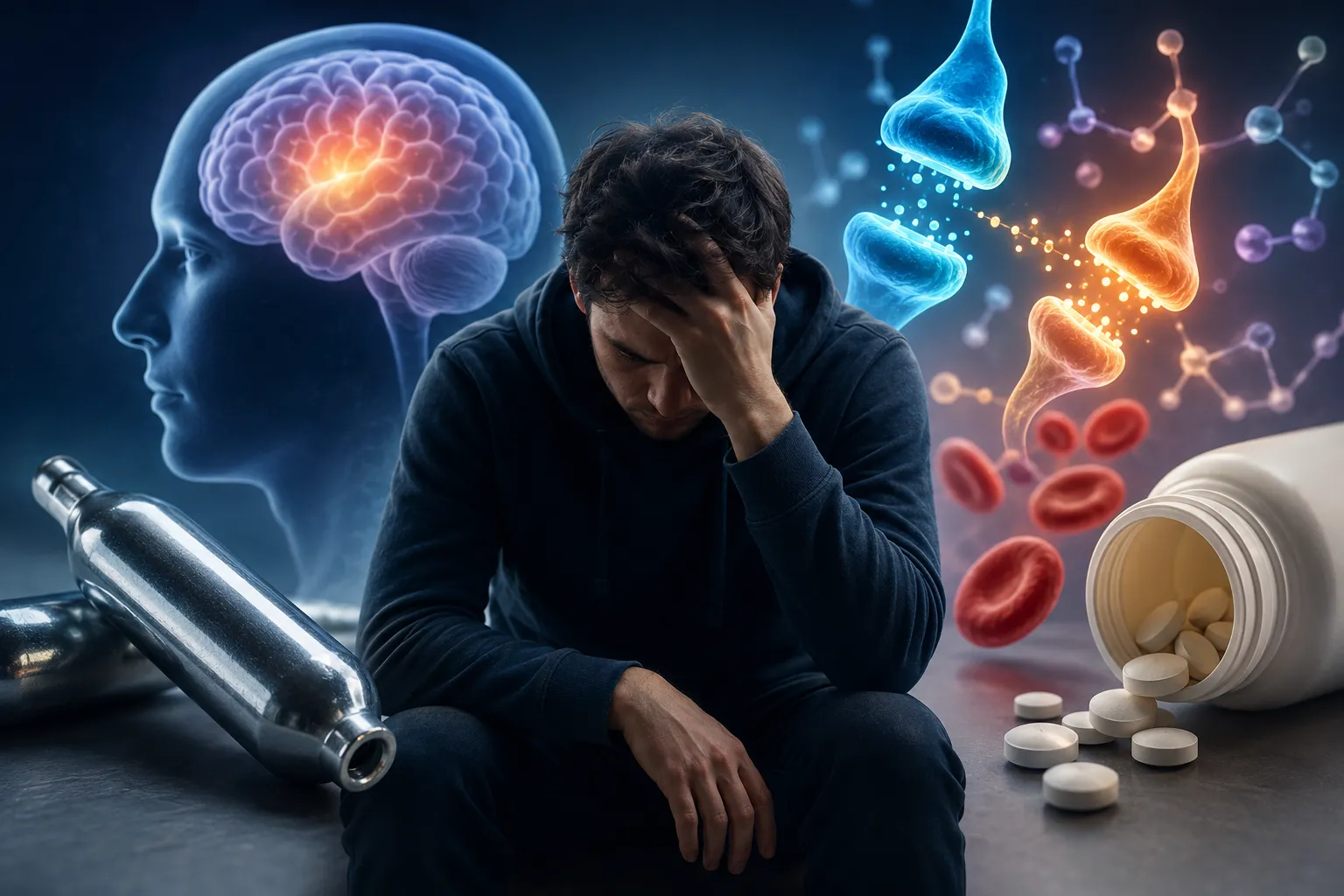
Nitrous oxide inactivates vitamin B12, which the body needs to produce serotonin and dopamine, the neurotransmitters that regulate mood. Depression linked to Galaxy Gas or Whip-Its use is a documented psychiatric consequence of this B12 depletion, not simply situational sadness. It often develops alongside other nitrous oxide symptoms and can persist until the underlying deficiency is treated.
Key Takeaways
- Vitamin B12 supports the production of serotonin and dopamine, both central to mood regulation.
- Depression tied to nitrous oxide use is a recognized medical consequence of B12 deficiency, separate from nitrous oxide's unrelated use as an experimental clinical antidepressant.
- Depression from nitrous oxide often appears alongside cognitive symptoms like brain fog and memory loss.
- Treating the B12 deficiency, not just the depression symptoms, is central to recovery.
- Michael Gunzburg, P.C. represents nitrous oxide injury victims nationwide on a contingency fee basis, with no upfront cost.
Can Nitrous Oxide Cause Depression?
Yes. Heavy or prolonged use of nitrous oxide from Galaxy Gas or Whip-Its can cause depression by inactivating vitamin B12. This is a real, documented psychiatric injury. It's not a side effect people imagine or exaggerate.
It's worth being direct about something confusing in the research right now. Nitrous oxide is also being studied in controlled clinical settings as a fast-acting treatment for depression. In that setting, doctors administer it in precise, monitored doses. That research has nothing to do with recreational use from a canister at home.
The mechanism behind depression from recreational misuse runs in the opposite direction. It's the B12 depletion from repeated, uncontrolled exposure that causes mood problems. It isn't a therapeutic effect, and the two situations shouldn't be confused.
Recreational nitrous oxide use through Galaxy Gas or Whip-Its involves repeated, high-volume inhalation with no medical oversight. That pattern depletes B12 fast. It doesn't deliver any controlled benefit the way a supervised clinical dose might. The depression that follows is a harm, plain and simple, not a side benefit of treatment.
Can Low B12 Cause Depression and Anxiety?
Yes, low B12 is a documented cause of both depression and anxiety. B12 acts as a cofactor for enzymes that build serotonin and dopamine. These are the two neurotransmitters most tied to mood. When B12 goes inactive, those pathways slow down. Mood regulation suffers as a direct result.
This same B12 depletion drives the cognitive impairment that nitrous oxide causes, including memory loss and brain fog. Depression and cognitive symptoms frequently show up together because they share this single root cause. A person dealing with both isn't facing two unrelated problems. Both are symptoms of the same underlying deficiency working on different parts of the brain.
Anxiety often shows up alongside the depression too. Some people describe a persistent, low-grade unease that doesn't match anything happening in their life at the time. That disconnect between mood and circumstances is itself worth paying attention to. It's a pattern doctors look for when B12 deficiency is on the table as a possible cause.
The good news is that this particular cause of depression and anxiety responds to treatment differently than depression rooted in life circumstances. Once B12 levels normalize, the neurotransmitter pathways have a real chance to recover.
Signs of B12-Related Depression From Galaxy Gas or Whip-Its
B12-related depression carries a few distinguishing features that separate it from ordinary situational depression. Common signs include:
- Depressed mood that started or worsened alongside regular nitrous oxide use
- Fatigue that feels physical, not just emotional
- Numbness or tingling in the hands or feet alongside low mood
- Memory problems or brain fog appearing at the same time
- Little connection between the depression and any specific life event
- Limited or no improvement from typical situational coping strategies
The physical symptoms are often the clue that points toward B12 deficiency rather than a purely psychological cause. Depression that arrives with numbness, tingling, or memory problems is telling a different story than depression that arrives on its own.
Doctors sometimes miss this connection at first, especially if a patient doesn't mention nitrous oxide use during an appointment. It's an easy detail to leave out, whether from embarrassment or because it doesn't seem relevant to a mood complaint. Being upfront about Galaxy Gas or Whip-Its use gives a doctor the information needed to test B12 levels and treat the actual cause instead of just managing symptoms.
A standard depression screening won't catch B12 deficiency on its own. It takes a specific blood test to confirm it, and that test only happens if a doctor knows to order it.
How Is Vitamin B12 Deficiency Treated?
B12 deficiency is typically treated with supplementation, either through oral B12 or injections, depending on how severe the deficiency is and how well the body absorbs it. A doctor determines the right approach after confirming deficiency through bloodwork.
Injections tend to work faster in more severe cases, since they bypass digestion entirely and put B12 directly into the bloodstream. Oral supplements can work well for milder deficiency, though absorption varies from person to person.
Mood improvement doesn't happen overnight. Neurotransmitter pathways need time to recover once B12 levels return to normal, and the timeline varies from person to person. Some people notice improvement within weeks. Others, particularly those with more severe or prolonged deficiency, take longer.
Treating the depression symptoms alone, without addressing the B12 deficiency underneath, tends to fall short. Antidepressant medication might ease some symptoms temporarily, but it doesn't fix the underlying cause. The broader neurological effects nitrous oxide causes share this same requirement: the root cause has to be treated for the symptoms built on top of it to fully resolve.
Does Nitrous Oxide Use Affect Antidepressants Like SSRIs?
Nitrous oxide use can complicate the picture for people already taking antidepressants like SSRIs. This deserves a real conversation with a doctor, not guesswork. B12 deficiency affects the same neurotransmitter systems that SSRIs work on. That overlap can make it hard to tell whether a medication is working as expected or whether B12 depletion is masking its effects.
Anyone taking antidepressants who has also used Galaxy Gas or Whip-Its should mention both to their doctor. Leaving out the nitrous oxide use, even out of embarrassment, makes it harder for a doctor to see the full picture.
This isn't the place for specific guidance about dosing or drug interactions. A doctor or psychiatrist needs full information about both the medication and the nitrous oxide use to make that call safely. General information online can't replace that conversation.
Is Depression From Nitrous Oxide Grounds for a Lawsuit?
Yes. Depression caused by B12 deficiency from Galaxy Gas or Whip-Its use is a legally recognized injury, and recreational use doesn't disqualify a claim. These cases rest on the manufacturer's failure to warn, not on how the product was used.
Galaxy Gas and Whip-Its manufacturers marketed these products in ways that made recreational misuse foreseeable, without adequately warning consumers about the psychiatric risks tied to repeated inhalation. The firm's nitrous oxide lawsuit overview covers claims involving both Galaxy Gas and Whip-Its. Depression sometimes appears alongside more severe psychiatric effects, including psychosis, particularly with heavier or prolonged use.
Depression that affects someone's ability to work supports a lost earning capacity claim. Michael Gunzburg's CPA credential, paired with his legal background, supports precise calculation of these economic damages when psychiatric injury has measurably reduced someone's ability to earn a living.
Documentation strengthens these claims. Medical records showing a B12 deficiency diagnosis, a psychiatric evaluation, and a timeline connecting the depression to nitrous oxide use all matter. Records showing missed work or reduced performance add further support for economic damages.
How Michael Gunzburg, P.C. Handles Nitrous Oxide Depression Claims
Michael Gunzburg, P.C. represents nitrous oxide injury victims nationwide, gathering medical records, working with medical and psychiatric experts to establish causation, and building the evidence needed to hold manufacturers accountable. Cases are handled on a contingency fee basis, so there's no upfront cost to start a free case evaluation.
Nitrous oxide litigation continues to develop. The firm's case news and updates blog tracks new developments for anyone following this area of law closely.
Statutes of limitations apply to nitrous oxide injury claims and vary based on when the injury was discovered. Victims experiencing depression after Galaxy Gas or Whip-Its use are encouraged to reach out for a free, confidential case review as soon as possible, since waiting can limit the compensation available.
Situational Depression vs. B12-Related Depression: How to Tell the Difference
| Feature | Situational Depression | B12-Related Depression From Nitrous Oxide |
|---|---|---|
| Onset | Tied to a specific life event or stressor | Develops alongside regular Galaxy Gas or Whip-Its use |
| Physical symptoms | Usually absent or secondary | Often includes numbness, tingling, or fatigue |
| Cognitive symptoms | Not typically a core feature | Frequently appears with brain fog or memory loss |
| Response to treatment | Often improves with therapy or situational change | Requires B12 treatment to fully resolve |
Frequently Asked Questions
Can nitrous oxide cause depression?
Yes. Heavy or prolonged use of Galaxy Gas or Whip-Its can deplete vitamin B12, which the body needs to produce serotonin and dopamine, the neurotransmitters most tied to mood regulation. This is separate from nitrous oxide's unrelated, medically supervised use as an experimental clinical antidepressant, administered in controlled doses by trained professionals. The depression that follows recreational misuse is a documented harm caused by uncontrolled B12 depletion, not a therapeutic effect, and it's a recognized psychiatric injury rather than something people imagine.
Can low B12 cause depression and anxiety?
Yes. B12 acts as a cofactor for enzymes involved in building serotonin and dopamine, both central to mood regulation. When B12 goes inactive, those neurotransmitter pathways slow down, and both depression and anxiety can result. Many people experience the two together, along with a sense that their mood doesn't match what's happening in their life. This same B12 depletion also drives the cognitive symptoms, like memory loss and brain fog, that often appear alongside the mood changes.
How is vitamin B12 deficiency treated?
B12 deficiency is typically treated with oral supplementation or B12 injections, depending on severity and how well the body absorbs the vitamin. Injections tend to work faster in more severe cases since they bypass digestion. A doctor confirms deficiency through bloodwork before recommending an approach, since a standard depression screening won't catch B12 deficiency on its own. Mood improvement takes time even after treatment starts, since neurotransmitter pathways need time to recover once B12 levels return to normal.
Does nitrous oxide affect antidepressants like SSRIs?
It can complicate the picture, since B12 deficiency affects some of the same neurotransmitter systems that SSRIs target. That overlap can make it hard to tell whether a medication is working as expected or whether B12 depletion is masking its effects. Anyone taking antidepressants who has also used Galaxy Gas or Whip-Its should mention both to their doctor so the full picture is available. General information online can't replace a real conversation with a doctor or psychiatrist about both the medication and the nitrous oxide use.
How long until mood improves after B12 treatment?
Timelines vary from person to person. Some people notice improvement within a few weeks of starting B12 treatment, while others, especially those with more severe or prolonged deficiency, take longer. Consistent treatment and stopping nitrous oxide use entirely both support faster improvement. Injections often produce faster results than oral supplementation in more severe cases, since they deliver B12 directly into the bloodstream rather than relying on digestion and absorption.
Is depression from nitrous oxide permanent?
Not necessarily. Many cases improve once B12 deficiency is treated and nitrous oxide use stops completely. Depression tied to more severe or long-term deficiency can take longer to resolve, and ongoing psychiatric support may be needed alongside B12 treatment for a full recovery. Early treatment generally offers the best chance at improvement, which is part of why connecting depression symptoms back to nitrous oxide use as soon as possible matters.
Can I sue for depression caused by Galaxy Gas or Whip-Its?
Yes. Recreational use doesn't disqualify a claim. These lawsuits rest on the manufacturer's failure to warn consumers about the psychiatric risks of repeated use, not on how the product was used. Michael Gunzburg, P.C. handles these claims on a contingency fee basis, with no upfront cost, and depression that affects someone's ability to work can support a lost earning capacity claim in addition to other damages.
Do I need a psychiatric diagnosis before contacting a lawyer?
A diagnosis strengthens a claim, but it isn't required to start a free case evaluation. An attorney can advise on what medical and psychiatric documentation to gather as the case develops. Reaching out early makes it easier to gather records and establish a clear timeline while the details are still fresh, rather than trying to reconstruct a timeline months or years later.