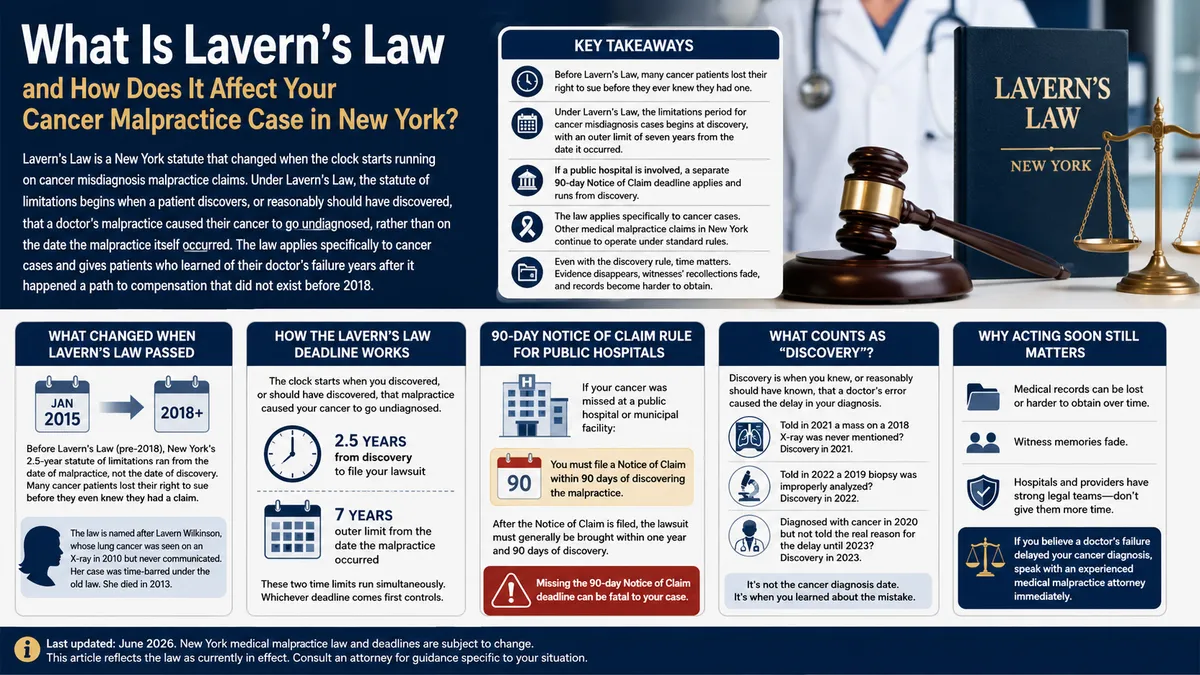
Lavern's Law is a New York statute that changed when the clock starts running on cancer misdiagnosis malpractice claims. Under Lavern's Law, the statute of limitations begins when a patient discovers, or reasonably should have discovered, that a doctor's malpractice caused their cancer to go undiagnosed, rather than on the date the malpractice itself occurred. The law applies specifically to cancer cases and gives patients who learned of their doctor's failure years after it happened a path to compensation that did not exist before 2018.
Last updated: June 2026. New York medical malpractice law and deadlines are subject to change. This article reflects the law as currently in effect. Consult an attorney for guidance specific to your situation.
Key Takeaways
- Before Lavern's Law, many cancer patients lost their right to sue before they ever knew they had one, because the clock ran from the date of the malpractice, not the date of discovery.
- Under Lavern's Law, the limitations period for cancer misdiagnosis cases begins when the patient discovers the malpractice, with an outer limit of seven years from the date it occurred.
- If a public hospital is involved, a separate 90-day Notice of Claim deadline applies and runs from when the patient discovers the malpractice.
- The law applies specifically to cancer cases. Other medical malpractice claims in New York continue to operate under standard rules.
- Even with the discovery rule, time matters. Evidence disappears, witnesses' recollections fade, and medical records can become harder to obtain as years pass.
What Changed When Lavern's Law Passed
Before Lavern's Law took effect in 2018, New York's standard medical malpractice statute of limitations ran 2.5 years from the date of the malpractice itself, regardless of when the patient found out about it. For cancer patients, this created a devastating problem.
A woman whose doctor failed to biopsy a breast lump in January 2015 might not learn that failure caused her cancer to advance until 2018 or later. Under the old rule, her deadline may have already passed. She had no claim, not because her case lacked merit, but because she did not know she had one while the clock was running.
Lavern Wilkinson was a Medicaid patient whose lung cancer appeared on a chest X-ray at Kings County Hospital in 2010. The finding was never communicated to her. By the time she learned of it, her cancer had spread and she was told it was terminal. Her case was time-barred under the old law because the malpractice had occurred more than 2.5 years earlier. She died in 2013. The New York legislature named the law after her.
How the Lavern's Law Deadline Actually Works
Lavern's Law amended CPLR 214-a to create a discovery-based limitations period for cancer misdiagnosis cases. The rule now works like this:
You have 2.5 years from the date you discovered, or should have discovered, that malpractice caused your cancer to go undiagnosed. That is when the clock starts. The discovery date is not when you were first diagnosed with cancer. It is when you learned, or reasonably should have learned, that a doctor's error caused the delay in that diagnosis.
The outer limit is seven years from the date the malpractice occurred. Even under the discovery rule, a claim cannot be brought more than seven years after the negligent act itself. If a doctor missed a cancer finding in 2015 and the patient does not discover that failure until 2023, the seven-year outer limit may bar the claim despite the discovery rule.
These two numbers, 2.5 years from discovery and seven years from the malpractice date, run simultaneously. Whichever produces the earlier deadline controls. An attorney calculates both from the specific facts of each case.
The 90-Day Notice of Claim Rule for Public Hospitals
Lavern's Law addresses when the limitations period begins. It does not eliminate a separate, strict procedural requirement that applies to any claim against a public hospital or municipal facility.
If your cancer was missed at NYC Health + Hospitals, a city-operated clinic, or any other government-run medical facility, you must file a Notice of Claim within 90 days of discovering the malpractice. Under Lavern's Law, that 90-day window runs from the discovery date, not the date of the malpractice, which is the same standard that applies to the main limitations period.
Missing the 90-day Notice of Claim deadline is one of the most common and most devastating mistakes in public hospital malpractice cases. Unlike the main statute of limitations, courts rarely excuse a late Notice of Claim in malpractice cases. The failure is often fatal to the claim entirely, regardless of how strong the underlying case is.
After the Notice of Claim is filed, the lawsuit itself must generally be brought within one year and 90 days of the discovery date.
If there is any possibility that a public hospital or city-run facility was involved in your care, contact an attorney before doing anything else. The 90-day window starts running from the moment you have reason to know malpractice occurred.
What Counts as "Discovery" of the Malpractice?
The discovery date under Lavern's Law is not necessarily the day you receive a cancer diagnosis. It is the date you knew, or reasonably should have known, that a doctor's error caused the delay in that diagnosis.
Courts look at when a patient had actual knowledge that a specific failure occurred, not just that something went wrong. For example:
- If a patient is told in 2021 that a mass visible on a 2018 chest X-ray was never mentioned to them, discovery arguably occurred in 2021.
- If a second physician tells a patient in 2022 that a 2019 biopsy was improperly analyzed, discovery arguably occurred in 2022.
- If a patient receives a cancer diagnosis in 2023 and only then learns from their oncologist that warning signs were present and documented as far back as 2020, the 2023 date may be the discovery date.
What a patient "reasonably should have discovered" adds an objective element. If information was available that a diligent patient would have pursued, courts may find constructive discovery occurred earlier than actual discovery. This is why the attorney and medical expert review of the full timeline is critical. The discovery date is not always obvious, and choosing the wrong one can mean either filing too late or losing the argument about when the clock started.
Does Lavern's Law Apply to Every Type of Cancer?
The statute as written applies to the "failure to diagnose cancer." It is not limited to specific cancer types. Breast cancer, cervical cancer, lung cancer, colon cancer, vulvar cancer, ovarian cancer, pancreatic cancer, and other malignancies all fall within the law's scope.
What Lavern's Law does not do is extend the discovery rule to non-cancer malpractice cases in New York. If a doctor missed a heart condition, delayed a stroke diagnosis, or failed to identify an infection, the standard 2.5-year limitations period from the date of malpractice continues to apply. The discovery-based rule is cancer-specific.
For patients whose cases involve both cancer and non-cancer malpractice claims, an attorney identifies which statute of limitations governs each element of the claim. Mixing up the applicable rules in these situations is a litigation error that can eliminate otherwise valid claims.
Why the Deadline Still Matters Even Under Lavern's Law
Lavern's Law gave cancer misdiagnosis patients more time. It did not give them unlimited time. Several practical realities make acting quickly still important.
Evidence deteriorates. Medical records are required to be retained for specific periods under New York law, but older imaging, pathology slides, and original reporting documents become harder to track down over time. In some cases, records are lost, archived off-site, or destroyed after retention periods expire. The earlier an attorney can preserve and subpoena these records, the more complete the evidentiary picture.
Witnesses' memories fade. The physicians, nurses, radiologists, and staff involved in the original care may retire, relocate, or simply remember less. Expert witnesses who review these cases depend heavily on what the records say. When records are incomplete, the case becomes harder to prove.
Insurance coverage changes. Physicians change insurers, join new practices, or retire. Hospitals restructure. Tracking the applicable coverage becomes more complex as time passes, and in some cases, available policy limits change.
Your own circumstances change. Understanding the full scope of your damages requires documenting your current condition and prognosis. Waiting to file can complicate that documentation and affect the calculation of future damages.
If you are in active cancer treatment and wondering whether you should wait until you finish before contacting an attorney, the answer is no. Michael Gunzburg, P.C. can begin investigating while you focus on your health. The statute of limitations does not pause for treatment.
Lavern's Law and the Wrongful Death Context
When a cancer misdiagnosis results in the patient's death, surviving family members may bring a wrongful death claim. New York's wrongful death statute carries its own limitations period: two years from the date of death. That deadline is separate from and does not extend under Lavern's Law.
A family member who dies from a cancer that was missed years earlier may have a wrongful death claim with a two-year clock running from the date of death, even if the malpractice itself occurred more than seven years ago. The wrongful death claim and the Lavern's Law claim are distinct legal theories with distinct deadlines, and a malpractice attorney calculates both.
The failure to diagnose cancer page at Michael Gunzburg, P.C. addresses both personal injury and wrongful death claims arising from diagnostic failures.
Frequently Asked Questions
What is Lavern's Law in New York?
Lavern's Law is a New York statute, codified at CPLR 214-a, that changed when the limitations period begins for cancer misdiagnosis malpractice cases. Before the law, the 2.5-year clock ran from when the malpractice occurred, even if the patient did not know about it. Lavern's Law changed the start date to when the patient discovered, or reasonably should have discovered, that malpractice caused the delay in their diagnosis. An outer limit of seven years from the date of malpractice still applies.
Does Lavern's Law apply to all medical malpractice cases in New York?
No. Lavern's Law applies specifically to cases involving failure to diagnose cancer. Standard New York medical malpractice cases, including missed diagnoses of non-cancer conditions, continue to operate under the original rule: the limitations period runs 2.5 years from the date of the malpractice, regardless of when the patient discovers it.
When does the Lavern's Law clock start running?
The clock starts when you discovered, or reasonably should have discovered, that a doctor's malpractice caused your cancer to go undiagnosed. That is not necessarily the date of your cancer diagnosis. It is the date you had reason to know a specific failure by a specific physician contributed to a delay. Because this date is fact-specific and legally significant, an attorney should be consulted to make this determination accurately.
What is the 90-day Notice of Claim rule under Lavern's Law?
If your missed cancer diagnosis occurred at a public hospital, government clinic, or other municipal facility in New York, you must file a Notice of Claim within 90 days of discovering the malpractice. This is a separate, strict procedural requirement on top of the main statute of limitations. Missing the 90-day window is almost always fatal to a claim against a public facility, regardless of the merits.
Can I still sue if more than 2.5 years have passed since my cancer was diagnosed?
Possibly, depending on when you discovered the malpractice. If you learned within the last 2.5 years that a doctor's failure caused your cancer to progress to a more advanced stage, and the malpractice itself occurred less than seven years ago, you may still have a viable claim under Lavern's Law. The only way to know for certain is a case evaluation with an attorney who can apply the specific dates of your situation to the applicable rules.
What happens to a Lavern's Law claim if the patient dies before filing?
If the patient dies before filing, surviving family members may bring a wrongful death claim under a separate statute with its own two-year deadline running from the date of death. The Lavern's Law limitations period and the wrongful death limitations period are independent of each other. Both are calculated separately by an attorney, and both deadlines apply simultaneously.
How is Lavern's Law different from the standard medical malpractice deadline?
The standard New York medical malpractice deadline runs 2.5 years from the date the negligent act occurred, regardless of when the patient learned of it. Lavern's Law creates an exception for cancer cases only, shifting the start date to when the patient discovered the malpractice, with a maximum outer limit of seven years from the date of the act. The result is that cancer patients who did not know a failure occurred until years later are not automatically time-barred.
How do I know if Lavern's Law applies to my case?
Lavern's Law applies if your claim involves a failure to diagnose cancer, the malpractice occurred within seven years of the present date, and you discovered the malpractice within the last 2.5 years. Because the discovery analysis is fact-intensive and the consequences of getting it wrong are permanent, consulting an attorney is the only reliable way to determine whether your case falls within the law's coverage and what your actual deadline is.
Schedule a Free Consultation
Understanding when your deadline falls under Lavern's Law requires applying specific dates to a legal framework that does not always produce obvious answers. Getting this calculation wrong eliminates your claim permanently.
Michael Gunzburg, P.C. has represented cancer misdiagnosis victims throughout Manhattan, Brooklyn, Queens, the Bronx, and Staten Island for 39+ years. The firm handles failure to diagnose cancer cases on a contingency fee basis. You pay nothing unless the firm wins.
If you believe a doctor's failure allowed your cancer to progress, or if you are a family member of someone who died from a cancer that was not caught in time, contact the firm before assuming your deadline has passed.
Call (212) 725-8500 for a free consultation, or contact the firm online. Calls are returned within 24 hours.