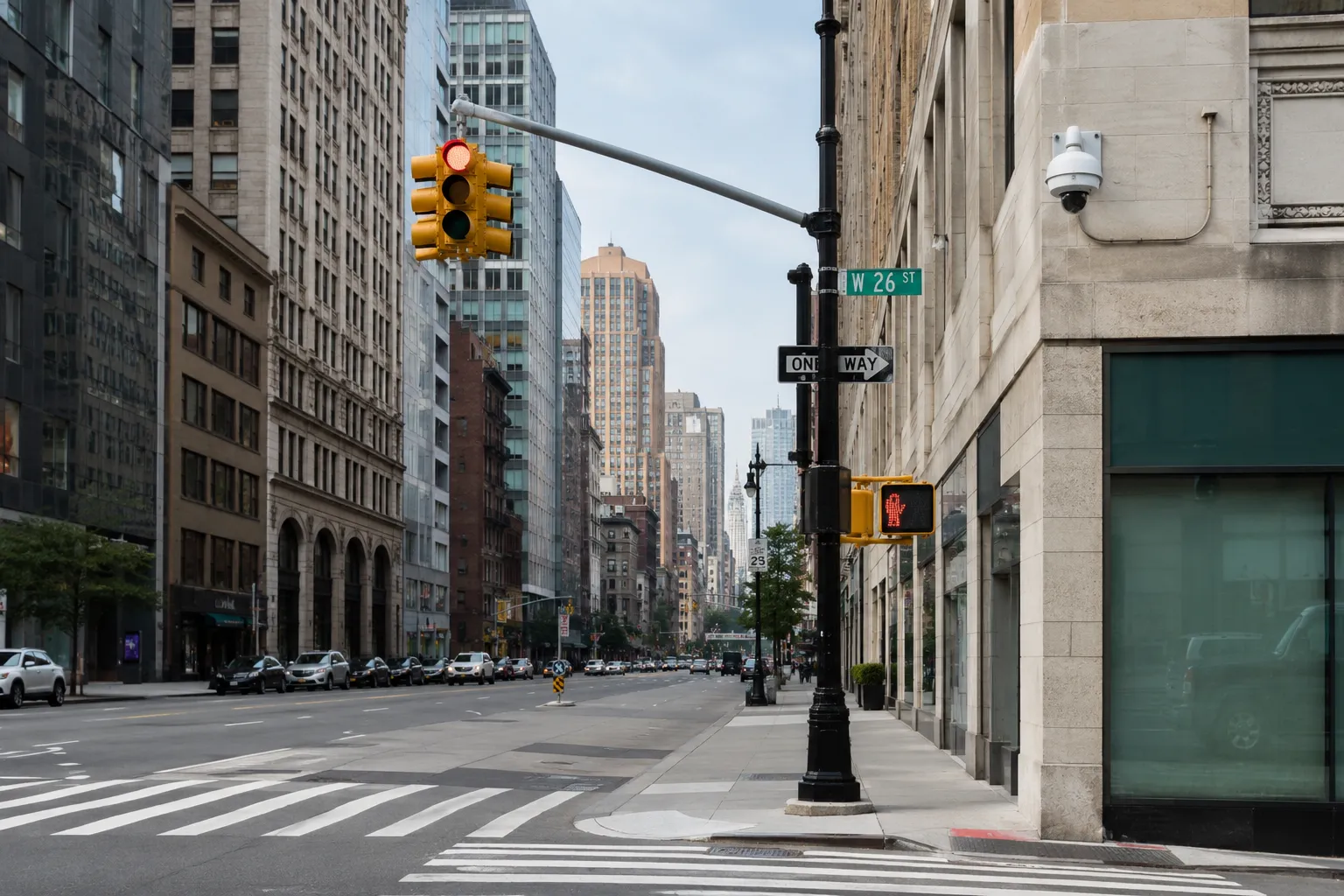
Proving fault in a Manhattan crosswalk accident requires evidence that the driver acted negligently, and that their negligence caused your injuries. In New York, fault is rarely all-or-nothing. Even if an insurer argues you share some blame, you may still recover significant compensation under the state's comparative negligence rules.
Key Takeaways
- Fault in a crosswalk accident turns on evidence: police reports, surveillance footage, witness statements, and medical records.
- A driver who fails to yield to a pedestrian in a crosswalk violates New York Vehicle and Traffic Law and is presumed negligent.
- New York's pure comparative negligence standard means partial fault on your part reduces, but does not eliminate, your recovery.
- Evidence must be preserved quickly, traffic camera footage is often overwritten within days.
- If a city-owned signal failure or road defect contributed to the crash, a Notice of Claim must be filed within 90 days.
What "Fault" Means in a New York Crosswalk Accident
Fault in a pedestrian accident case is a legal conclusion built from facts. To hold a driver liable, your attorney needs to show four things: the driver had a duty to exercise reasonable care, they breached that duty, the breach caused the accident, and you suffered damages as a result.
For crosswalk accidents, the duty element is well-established. Under New York Vehicle and Traffic Law Section 1151, drivers must yield to pedestrians in marked and unmarked crosswalks at intersections. A driver who strikes a pedestrian while they are crossing legally has almost certainly breached that duty. The more contested questions in most cases are causation and the degree of each party's fault.
New York's pure comparative negligence standard under CPLR Article 14-A means that fault can be split between multiple parties. If you are found 20% at fault for the accident, your damages are reduced by 20%. Insurance companies exploit this by routinely attributing fault to pedestrians, arguing distraction, an early start, or crossing slightly outside the lines. Building a strong evidence record is the most effective counter to those arguments.
What Evidence Proves Fault in a Manhattan Crosswalk Accident
Police Report
The first piece of evidence in almost every case is the police report. When officers respond to the scene, they document the parties involved, the location, any visible injuries, and their initial assessment of what happened. A notation in the report that the driver failed to yield, ran a red light, or was using a phone carries significant weight with insurers and juries.
Request the report as soon as it is available through the NYPD. If the responding officer did not note fault, that does not end the inquiry, other evidence can establish negligence independently.
Surveillance and Traffic Camera Footage
Manhattan is one of the most surveilled cities in the world. Traffic cameras operated by the NYC Department of Transportation, NYPD cameras, and private security cameras on nearby businesses and residential buildings may have captured the accident on video.
This footage is the single most powerful form of evidence in a crosswalk accident case, and it disappears fast. Many systems overwrite footage within 24 to 72 hours. Preserving it requires a prompt preservation letter sent to the relevant agencies and property owners before the footage is gone. This is one of the most time-sensitive steps after any Manhattan pedestrian accident, and it is one reason contacting an attorney quickly matters.
For cases where a distracted driver was involved, phone records and data from the vehicle may also be recoverable. The distracted driving accident page covers that evidence process in more detail.
Witness Statements
Bystanders at a busy Manhattan intersection often see exactly what happened. Witnesses who saw the driver run a light, fail to check before turning, or strike you while looking at a phone can provide statements that corroborate your account and counter the driver's version of events.
Get contact information from anyone who stopped at the scene. If witnesses have already left, an attorney can sometimes track them down using nearby business records or social media posts about the accident.
Traffic Signal Data and Intersection Records
NYC DOT maintains data on signal timing and phasing for intersections across Manhattan. In cases where signal timing is contested, for example, whether the driver had a green arrow or a general green light, this data can clarify exactly what each party's signal showed at the moment of impact.
NYC DOT records can also reveal prior complaints or documented problems at the same intersection. If the city knew about a dangerous condition and failed to fix it, that information supports a claim against the municipality. These cases require the 90-day Notice of Claim under New York General Municipal Law Section 50-e, so acting quickly is essential.
Medical Records
Medical records establish the link between the accident and your injuries. Gaps in treatment, delays in seeking care, or pre-existing conditions in the same area of the body are commonly used by defense attorneys to argue that your injuries were not caused by the accident. Consistent, documented medical care from immediately after the accident forward is the strongest way to maintain that causal link.
If your injuries include a traumatic brain injury, the documentation process is particularly important. TBIs are often invisible on initial imaging and may not be fully diagnosed until follow-up evaluations. The traumatic brain injury page covers what to expect from that process.
How Insurance Companies Challenge Fault
Accepting that a driver hit a pedestrian in a crosswalk does not mean the insurer will accept full liability. The most common arguments used to shift or reduce fault onto the pedestrian include:
The pedestrian started crossing on a flashing signal. Many pedestrians begin crossing legally on a solid walk signal and are still in the crosswalk when it begins flashing. Flashing does not mean stop, it means do not start crossing. A pedestrian who began crossing on a solid walk signal and was hit while finishing their crossing is not at fault.
The pedestrian was distracted. An insurer may argue that a pedestrian looking at their phone failed to notice an approaching vehicle and could have avoided the collision. Whether this rises to contributory negligence depends on the specific facts, but it is a common tactic.
The pedestrian was outside the crosswalk lines. Pedestrians do not need to walk in a perfectly straight line through a crosswalk. However, if a pedestrian drifted significantly outside the marked area, this may be raised as a fault issue. The weight of this argument depends heavily on how far outside the lines they were and whether it materially contributed to the accident.
An attorney familiar with Manhattan crosswalk accident claims can anticipate these arguments and build a factual record that counters them before they gain traction with the insurer.
What Should You Do at the Scene to Protect Your Claim?
The steps you take immediately after the accident shape the evidence available to your attorney later.
Call 911 and wait for police to arrive. Do not accept the driver's offer to handle things privately. A police report creates an official record that is far harder to dispute than a driver's later account of events.
Photograph everything while you are still at the scene: the crosswalk markings, the traffic signals, the vehicle, the driver's license plate, the position of the vehicle relative to the crosswalk, and any visible injuries. If your phone is damaged or unavailable, ask a bystander to take photos and send them to you.
Do not say you are fine, and do not apologize. Both can be construed as admissions. Get the driver's name, license, insurance information, and vehicle registration. Note the time, the signal state, and any relevant conditions like visibility or weather.
As detailed in this article on what not to say after a pedestrian accident, early statements are among the most damaging mistakes injured pedestrians make.
Frequently Asked Questions
How do you prove a driver was at fault in a crosswalk accident?
Fault is proven through a combination of evidence: the police report, surveillance footage showing the driver's actions, witness statements, traffic signal data, and medical records connecting the accident to your injuries. In New York, a driver who strikes a pedestrian in a crosswalk while the pedestrian has the walk signal has almost certainly violated VTL Section 1151, which is strong evidence of negligence.
What if there are no witnesses to my crosswalk accident?
Cases without eyewitnesses are not unwinnable. Traffic camera footage, the physical evidence at the scene, the positions of the vehicles and pedestrian after impact, and the police report can all establish what happened. An attorney can also request data from the driver's vehicle, including speed and braking records, which modern vehicles record automatically.
Can I still recover compensation if I was partly at fault?
Yes. New York's pure comparative negligence law allows you to recover even if you were 50% or more at fault. Your damages are reduced proportionally. For example, if you are found 30% at fault and your damages total $150,000, you recover $105,000. The key is not to let an insurer inflate your fault percentage without a factual basis.
How quickly does surveillance footage need to be preserved?
Immediately. Many NYC traffic and business security cameras overwrite footage within 24 to 72 hours. A formal preservation letter must be sent to the relevant parties before that window closes. This is one of the most urgent steps after a Manhattan crosswalk accident and a primary reason why contacting an attorney the same day or the next day matters.
What if the driver claims I walked out in front of them?
This is one of the most common defenses in crosswalk accident cases. It is countered with evidence, footage showing when you entered the crosswalk, witness accounts, the signal state at the time, and the vehicle's speed and braking data. A driver who had a clear view of a pedestrian in the crosswalk and still struck them has little credible basis for that claim.
Does it matter which direction the driver was coming from?
Yes. Left-turn and right-turn crash scenarios differ in how fault is assessed. A driver turning left must yield to oncoming traffic and to pedestrians crossing in front of them. A driver turning right on red must yield to pedestrians before completing the turn. The direction of travel affects which traffic laws apply and which violations can be established.
What if a city-owned signal malfunction contributed to my accident?
If a broken or mistimed signal contributed to the crash, the City of New York may share liability. You must file a Notice of Claim within 90 days of the accident under New York General Municipal Law Section 50-e. A lawsuit against the city must follow within one year and 90 days. Missing the Notice of Claim deadline typically bars your claim against the city permanently.
How long do I have to file a crosswalk accident lawsuit in New York?
Three years from the date of the accident for a claim against a private defendant such as the driver. Two years for wrongful death. For claims involving the City of New York, the 90-day Notice of Claim deadline applies in addition to the shortened lawsuit filing period of one year and 90 days.
Talk to a Manhattan Pedestrian Accident Attorney
Building a fault case after a Manhattan crosswalk accident takes immediate action, the right evidence, and an attorney who knows how to counter the arguments insurers use to minimize payouts. Michael Gunzburg, P.C. has represented pedestrian accident victims across Manhattan for over 39 years, recovering substantial results in cases involving serious crosswalk injuries.
If you were struck in a Manhattan crosswalk, contact Michael Gunzburg, P.C. at (212) 725-8500 for a free consultation. There is no fee unless you recover. You can also start with a case evaluation online.
Related Pages:
- Manhattan Pedestrian Accident Lawyer
- Manhattan Crosswalk Accident Claims
- Manhattan Hit-and-Run Pedestrian Accidents
- NYC Intersection Accident Lawyer
- Distracted Driving Accidents NYC
- Traumatic Brain Injury After a Pedestrian Accident
The information in this article reflects New York law as of June 2025. This article is for informational purposes only and does not constitute legal advice. Contact Michael Gunzburg, P.C. directly for guidance specific to your situation.